
Share This Post
What Does a Professional Rigging Inspection Actually Cover?
From deck level, a yacht’s rig can appear to be in perfectly good condition. The mast looks straight, the shrouds remain under tension and there are no obvious broken wires or damaged fittings.
Reassuring as this may be, appearances do not tell the whole story.
Many of the rig’s most critical load-bearing components are located aloft, inside terminal assemblies or beneath fittings where corrosion, fatigue, movement or incorrect seating may not be immediately visible.
A professional rigging inspection goes beyond looking for obvious damage. Its purpose is to build a clearer picture of the rig’s condition, identify warning signs and establish whether maintenance, further investigation, repair or replacement should be considered.
Deck-level checks are important — but they have limitations
Routine checks carried out by the owner or crew are an essential part of good yacht maintenance. They may reveal frayed lines, loose split pins, visible corrosion, distorted fittings or unexpected changes in rig tension.
Our pre-passage rigging inspection checklist provides a useful starting point for these regular checks.
However, a deck-level inspection cannot provide a clear view of the entire mast. It will not allow the inspector to examine the masthead, upper terminals, spreader roots, halyard exits or many other fittings in sufficient detail.
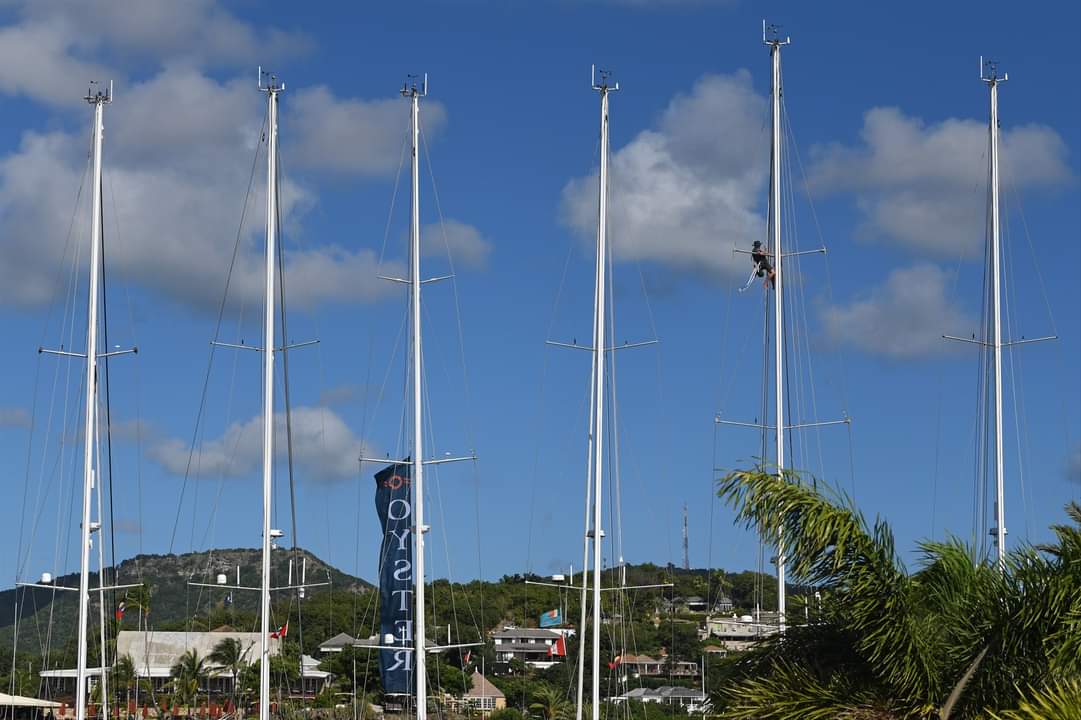
Some components can only be properly assessed after the rig has been slackened, a fitting has been removed or the mast has been unstepped. Work aloft and any intervention involving loaded rigging components should always be undertaken by competent professionals using the correct equipment and procedures.
The scope depends on the yacht
There is no single inspection procedure or service interval that is suitable for every yacht.
Before defining the scope of an inspection, several factors should be considered:
- The type of standing rigging: wire, rod or composite.
- The mast material and design.
- The age of the rigging components.
- The yacht’s mileage and sailing programme.
- Previous maintenance, repairs and modifications.
- The rigging manufacturer’s recommendations.
- Any history of impact, overloading or accidental damage.
- The yacht’s future sailing plans.
A yacht used for occasional coastal cruising will not experience the same loads or service conditions as an offshore cruising yacht, a racing boat or a professionally crewed superyacht.
The inspection and maintenance programme should therefore be based on the actual rigging system, its service history and how the yacht is used — not simply on its age.
What can a professional rigging inspection include?
The exact scope should be agreed before work begins, but a professional inspection may cover the following areas.
1. Service history and sailing profile
A review of the available service records helps the rigger understand what has been installed, when previous inspections took place and whether any components have already been repaired or replaced.
Information from the captain, owner or crew can also be valuable. A recent change in mast tune, unusual noise, recurring halyard chafe or a fitting that repeatedly works loose may help direct attention to a developing issue.
Where no reliable service history exists, a more detailed inspection or additional investigation may be recommended.
2. Inspection at deck level
The inspection will normally begin with the components that can be accessed safely from deck level. These may include:
- The mast heel, mast step and surrounding structure.
- The partners and sealing arrangements on a keel-stepped mast.
- Lower shroud and stay terminals.
- Turnbuckles or rigging screws.
- Clevis pins, split pins and locking arrangements.
- Accessible chainplates and attachment points.
- Signs of corrosion, cracking, distortion or movement.
- Evidence of water ingress around deck fittings.
- Chafe or misalignment at load-bearing connections.
The visible section of a chainplate does not necessarily reveal the condition of the complete fitting or the structure supporting it. Corrosion staining, movement, cracking or water ingress may indicate that further access and investigation are required.
3. Inspection aloft
Aloft inspection provides access to areas that cannot be properly assessed from the deck. Depending on the mast and rig configuration, the rigger may examine:
- Masthead fittings.
- Shroud and stay attachment points.
- Tangs and terminal seats.
- Spreader roots, tips and end fittings.
- Sheaves and halyard exits.
- Tracks, fasteners and moving components.
- Areas showing chafe, corrosion or distortion.
- The attachment of aerials, navigation lights and other equipment.
The inspector is not simply looking for a broken component. Small changes in alignment, polishing caused by movement, fretting, deformation or corrosion staining can all provide useful information.
No load-bearing fitting should be disturbed while under load unless the work has been properly planned and the system made safe.
4. Standing rigging
The standing rigging supports the mast and transfers significant loads throughout the yacht’s structure. Its condition must be assessed according to the material and system installed.
A wire stay, a rod head and a composite stay do not age or display damage in the same way. Each requires the appropriate inspection criteria and manufacturer guidance.
The inspection may consider:
- Shrouds, stays, forestay and backstay.
- Terminals, swages, rod heads and associated fittings.
- Correct seating and alignment.
- Broken strands, cracking, corrosion or distortion.
- Wear caused by movement or contact.
- Pins, toggles and locking arrangements.
- Any sign that a component has been overloaded or incorrectly installed.
Surface condition is only part of the assessment. Some highly loaded areas may remain concealed inside terminal fittings and cannot be fully evaluated during a basic visual inspection.
5. Running rigging and associated equipment
Where included within the agreed scope, the inspection may also cover:
- Halyards, sheets and control lines.
- Covers, splices and rope terminations.
- Localised chafe at clutches, winches and sheaves.
- Shackles and connecting hardware.
- Blocks and deck organisers.
- Furling systems.
- Line movement through the mast and deck hardware.
A halyard may look perfectly serviceable along most of its length while suffering significant wear at the exact point where it passes over a sheave, through a clutch or around a winch.
6. Mast alignment and rig tune
Correct rig tune affects both sailing performance and how loads are distributed through the mast, standing rigging and hull structure.
Where rig tuning forms part of the work, the rigger may assess mast alignment, rake, prebend and relative rig tension. Measurements should be evaluated against the applicable specifications for the mast, rigging system and yacht.
There is no universal tension value that can be safely applied to every rig. Judging tension by hand is not a substitute for the correct measurements and manufacturer information.
7. Findings and recommendations
The findings should be recorded clearly enough for the owner, captain or yacht manager to understand what has been inspected and what action is recommended.
Depending on the agreed service, the findings may distinguish between:
- Safety-critical defects requiring immediate attention.
- Maintenance or repairs that should be scheduled.
- Components requiring further investigation.
- Items that should be monitored.
- Recommended replacement work.
- Areas that were inaccessible or outside the inspection scope.
Photographs and a consistent service history are particularly useful when monitoring changes over time and planning future refit work.
When a visual inspection is not enough
A visual inspection cannot always establish the full condition of a component.
If there is a specific concern, it may be necessary to slacken the rig, remove and clean individual fittings, unstep the mast or carry out non-destructive testing, commonly known as NDT.
NDT can help identify certain discontinuities or surface defects that may not be visible during a routine inspection. However, it is not a universal test for the entire rig and it does not predict exactly how much service life remains in a component.
The method must be suitable for the material, component and type of defect being investigated. For this reason, NDT should be specified and interpreted by appropriately qualified professionals as part of a wider technical assessment.
When should you arrange a professional rigging inspection?
In addition to the service programme recommended for the particular rigging system, professional advice should be sought when:
- The rig’s maintenance history is incomplete or unknown.
- You have recently purchased a pre-owned yacht.
- The yacht is preparing for a long or demanding passage.
- The rig has been exposed to severe weather or a suspected overload.
- An accidental gybe or other significant rigging incident has occurred.
- New noises, vibrations or unexpected movement appear.
- The mast shape, alignment or apparent tension has changed.
- Broken wires, cracks, corrosion or distortion are visible.
- The yacht is undergoing a refit or major modification.
- An inspection or service is required by the rigging manufacturer.
Visible warning signs should never be ignored simply because the next scheduled service date has not yet arrived.
An inspection is a snapshot, not a lifetime guarantee
A professional inspection provides information about the observable condition of the rig at the time it is examined. It helps identify warning signs, establish priorities and support better maintenance decisions.
It cannot eliminate every risk or guarantee that a component will not fail in the future.
The real value of regular inspection lies in identifying problems early, maintaining an accurate technical history and preventing minor issues from developing into more serious and costly failures.
Professional rigging inspections in Mallorca and Barcelona
At The Rigging Point, we provide professional rigging inspections, mast services, maintenance, repairs and installation. Where appropriate, the scope of the work can include further investigation and NDT.
Every yacht is assessed according to its rigging system, materials, service history and future sailing programme.
If your rig’s history is unclear, you have noticed something unusual or you are preparing for a major passage, contact our team and discover our professional rigging services.
A thorough inspection is not simply about finding damage. It gives you a clearer understanding of your rig, allows maintenance to be planned properly and helps you make informed decisions before heading back to sea.
Technical references

Suscríbete para enterarte de todo
Subscribe so you don't miss anything
Más por navegar

When to Unstep Your Mast: What to Check and How to Plan It
Some checks can be done from a bosun’s chair. Others are only done properly with the mast ashore, resting on trestles at eye level. Unstepping is one of those jobs many owners keep postponing, until a problem forces it in a hurry and in the middle of the season.
In this guide we look at when unstepping makes sense, what gets inspected with the mast down and how to plan it so your winter refit runs smoothly.

Rod vs Wire vs Composite Rigging: Choosing the Right Standing Rigging
Sooner or later, every owner and captain faces the re-rig question: stay with wire, move to rod, or go composite? There is no single right answer. Each material brings genuine advantages and trade-offs, and they are worth understanding before you ask for a quote.
In this guide we compare the main types of standing rigging from a rigger’s point of view: how they behave under sail, what maintenance they need, how long they last and which boats and programmes they suit best.
